TeamON partner brief
Operational AI
built into the business.
TeamON orchestrates the full system: workflow, agents, models, context, permissions, actions, interfaces and operations. The company gets an operational business function in a controlled environment — not another AI pilot.
- model- and runtime-agnostic
- deployment in infrastructure you control
- human oversight and a named operator
- one foundation for every new function
How to explain TeamON in 30 seconds
We turn one repeatable workflow into a managed AI business function: connect company data and systems, define roles and permissions, automate approved steps, and measure the result. Existing models, agents and integrations stay where they already work.
The client gets a dedicated operating environment with a business KPI, explicit permissions, human approval and clear sign-off criteria — not another chatbot.

01 · Product
What the company actually gets
Not a model licence or an empty platform. The company gets a working business function and a foundation for launching the next ones.
Business function
Completes a defined job end to end and moves an agreed business KPI.
Core productTeamON engine
Encodes the workflow, roles, context, permissions, state, interfaces and versions.
Product foundationCompany instance
An isolated environment with the company’s data, connections, rules and access controls.
Client environmentImplementation and operations
Process discovery, integrations, testing, team enablement, client sign-off and continuous improvement.
Path to the outcomeProcess contract
Trigger, 3–5 connected tasks, business KPI and sign-off criteria.
Method and roles
Operating rules, checks, skills and reasons for human handoff.
Context
Company terms, entities, examples, exceptions and decision history.
Actions
Approved CRM systems, spreadsheets, email, files, channels and APIs.
Control
Outcome owner, operator, permissions and approval of high-risk actions.
Workspace
Conversation, working canvas, files and management dashboard.
Reliability
Versioning, monitoring, backup, recovery and rollback.
Development
New rules and functions are tested and added to the same foundation.
02 · Why TeamON
Not another model. A system that runs real business processes
ChatGPT, Claude, Codex and agent frameworks remain valuable tools for individuals. TeamON is for business workflows that must run reliably, safely and without depending on a single internal champion.
| If you build it piece by piece | What TeamON adds |
|---|---|
| A model and personal prompts High-quality output for one person. |
Outcome contract Trigger, tasks, KPI, accountable owner and sign-off criteria. |
| A separate bot for every task Separate servers, rules and history. |
One foundation The next functions reuse the same environment, roles and controls. |
| Brittle point-to-point scripts Permissions and exceptions are scattered across the code. |
Controlled actions Permissions, approvals, audit trail and human handoff. |
| Knowledge trapped with one champion When that person leaves, progress stops. |
Company context Methods, rules and decisions live in a versioned environment. |
| A prototype that works in a demo It works only while its author keeps it running by hand. |
Operations Monitoring, updates, recovery, training and an operator. |
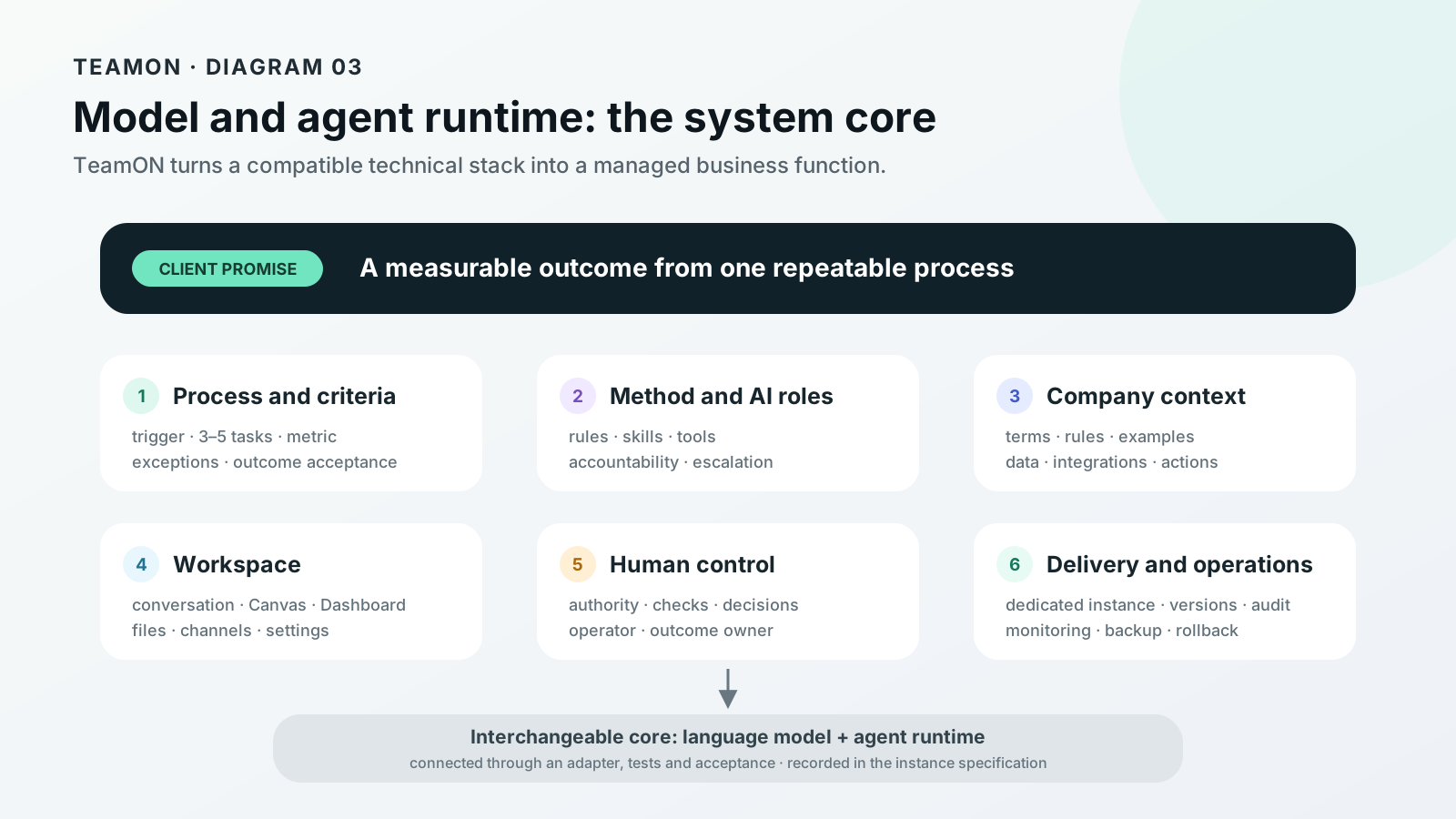
Agent runtime
An external agent framework (harness), TeamON’s own core or the client’s platform — connected through an adapter, tested and signed off.
Language model
Cloud, enterprise or local. We choose it based on quality, security, speed and process cost.
Existing AI stack
We keep prompts, agents and integrations that already work. We do not rebuild the system for the sake of a technology label.
Swap technology without rebuilding the operation
TeamON separates the process, context, permissions and interface from any specific model or execution environment. A change requires validation, not a new product built from scratch.
model, agent runtime or hosting changes → the validated business workflow remains intact
03 · Initial use cases
Start where money and delays are visible
These are starting configurations, not ready-made industry packages. We prove the impact using each company’s own data.
Sales
Handling inbound enquiries
The system gathers context, qualifies the request, prepares the reply and next contact, then records the outcome in the CRM.
- fewer lost leads;
- faster first response;
- more meetings and deals.
We measure: response time, leads without a next step, meetings and conversion.
Marketplaces
Margin and cash-leakage control
The system consolidates approved data and detects stock-out risk, negative margins and inefficient advertising.
- see financial risk earlier;
- reduce losses;
- remove manual monitoring.
We measure: detection time, missed exceptions, losses prevented and team hours.
Owner
Operational control
The system collects status from several sources and highlights deviations, owners and deadlines.
- faster management decisions;
- less manual status gathering;
- issues do not remain unowned.
We measure: hours spent compiling updates, overdue items, unowned tasks and time to decision.
Check the economics first
If the expected impact does not comfortably cover implementation and ongoing work, we do not sell that process.
incremental profit + labour saved + losses prevented − operating cost
04 · How it works
From answer to action
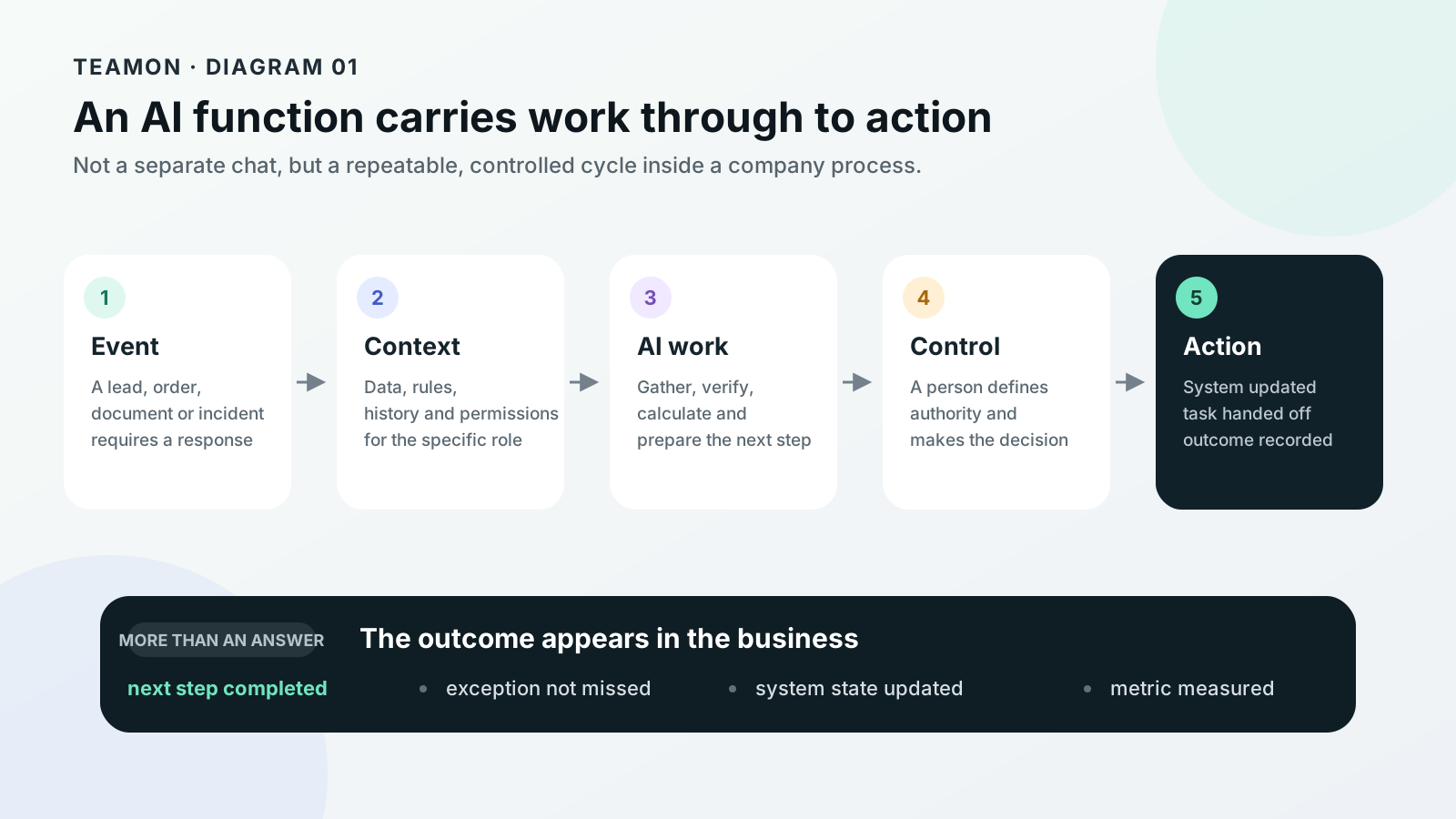
The outcome is not a summary or a list of “next steps”. A verifiable change must appear in the actual workflow.
- EventA lead, order, document or incident requires a response.
- ContextThe system reads only approved data, rules and operating history.
- AI workIt gathers, checks, calculates and prepares an action.
- ControlA person makes the decision whenever the cost of error is high.
- OutcomeThe task is handed off, the record is updated and the metric is measured.
05 · Implementation
Launch ends when the business function is signed off
We do not hand over an “installed server”. The client validates the complete path on its own data, from event to outcome.
Select the business case
Identify a recurring loss, an owner and a metric. Deliverable: a use case with credible economics.
Define the process
Document the trigger, 3–5 tasks, exceptions and baseline metric. Deliverable: signed workflow and acceptance criteria.
Design the environment
Choose hosting, AI core, sources and permissions. Deliverable: delivery architecture and access matrix.
Build the function
Deploy the instance and configure roles, context and actions. Deliverable: a working client instance.
Test safely
Run real scenarios without risky external effects. Deliverable: tests and an exception log.
Go live and sign off
Launch the process, train the team and hand over the operating procedure. Deliverable: a production function signed off by the client, plus the chosen support model.

06 · Hosting and security
Deploy on TeamON, partner or client infrastructure
Physical hosting does not change the product. Before launch, we define infrastructure ownership, data boundaries, access, backups and responsibilities.
TeamON infrastructure
Fast, managed launch. TeamON is responsible for the agreed technical environment.
Managed by TeamONPartner infrastructure
The partner hosts the industry or client environment; operating responsibilities are defined in the delivery agreement.
Managed by the partnerClient infrastructure
Maximum company control: its server or cloud, accounts, data and access policies.
Managed by the clientEach option undergoes its own readiness review and user acceptance. A fully closed environment requires a local or approved internal model and local integrations.
Knowledge sovereignty
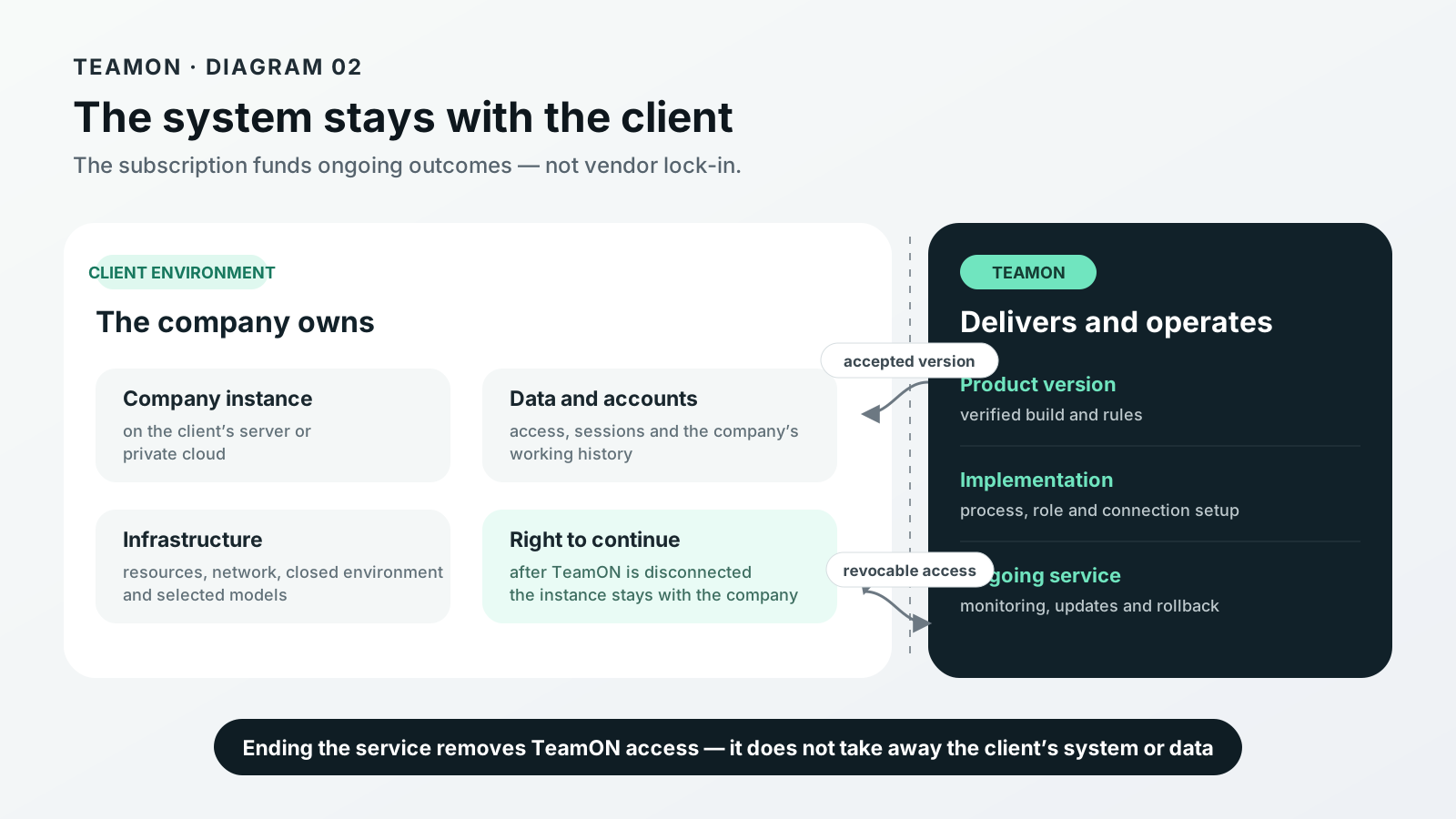
Hosting can change. The company keeps its accumulated knowledge.
All knowledge produced by the agent from a company’s data and work remains that company’s asset: context, accepted decisions, rules, exceptions and client-specific adaptations. This remains true even when the instance runs on TeamON or partner infrastructure.
TeamON servers = partner servers = client servers → knowledge and outcomes belong to the company

The client owns
- its company instance and state;
- its data, accounts and source systems;
- its context, accumulated decisions, rules and exceptions;
- client-specific adaptations within the agreed contractual scope;
- the right to export and move its environment.
TeamON is responsible for
- platform code and common methodology;
- product version and secure delivery;
- team training and operating procedures;
- limited, revocable access;
- updates, recovery and rollback.
Where is the intellectual-property boundary?
The company retains its data, context, outcomes and accepted client-specific adaptations. TeamON retains the platform code, product foundation and common methods that existed before the project. Client experience can become a shared improvement only with permission, after data removal and a separate review.
Can it run in a fully closed environment?
The architecture supports it. A fully closed deployment requires a local or approved internal model, a compatible agent runtime and local integrations. That configuration needs its own design and acceptance cycle; our internal instance is not evidence of a production-ready air-gapped deployment.
Can the system be installed on the client’s computer or server?
Yes. A client computer can be used for a simple local installation. For a continuously running business function, a dedicated server or enterprise cloud with backups and access control is preferable.
07 · Workspace
Users see the work, not a technical console
Complex work happens in the browser workspace. Quick requests can arrive through Telegram or another approved channel.
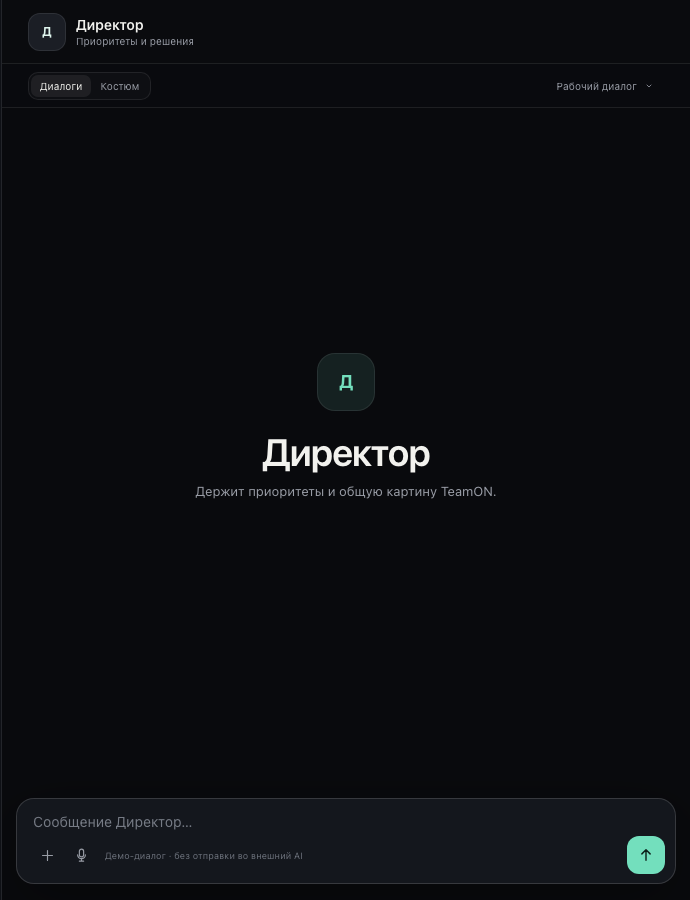
Persistent roleIts own instructions, skills, tools and working context.
Continuous conversationThe conversation continues when the working view changes.
Working canvasThe agent creates a task-specific deliverable and revises it on request.
Company dashboardOutcomes, deviations, owners and deadlines without copying private conversations.
Files and dataCSV/JSON files and approved sources are connected for the process.
Events and schedulesThe function can be triggered by a message, a business event or a schedule.
TeamON App
The main workspace: roles, conversations, work surface, outcomes and settings.
Available in StaffWork channels
Web, Telegram, MAX and other channels connect to the right role inside a specific instance.
Configuration-dependentDesktop and Extension
An auditable local bridge to applications and the browser: on-screen context stays local, while approved actions run in place.
Foundation exists · integration in progressOperator MCP
One controlled operator interface to the selected instance: inspect, prepare, apply and verify the result.
Operator control planeAI embedded in the flow of work
We are building an adaptive interface that follows the task while the agent works inside an approved application or browser tab. Access boundaries stay visible, and the agent explains each intended action before it runs.
observation → explanation → shadow mode → assistance → limited autonomy
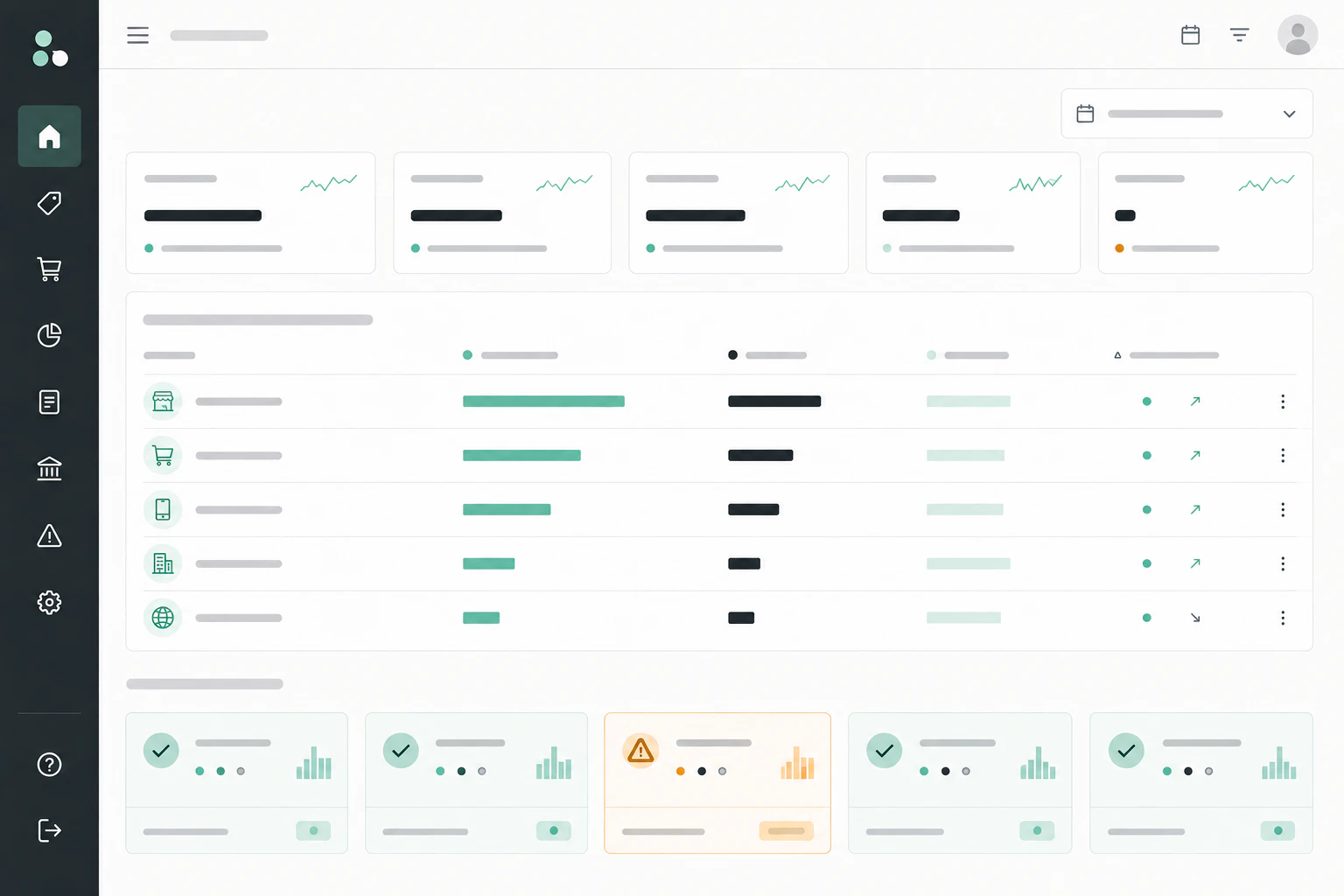
The screenshot proves that the interface exists, not that an external client deployment is ready. Universal upload of PDF, DOCX, XLSX and image files into every chat has not yet been proven; formats are validated case by case. The full “observation → autonomy” cycle is a development direction, not a ready feature in every instance.
08 · Ongoing service
The subscription funds ongoing outcomes
The implementation remains usable without mandatory managed service. The subscription applies when TeamON continues to operate, improve or extend the function.
Technical support
We monitor availability, fix incidents, release updates, make backups and restore the system.
Operational service
A named operator monitors the metric, handles new exceptions and releases verified improvements. The current RUB 70,000–100,000 monthly range is still being tested with the market.
Agents improve through controlled versions
A new rule never appears silently. The operator explains the change, tests it without external effects, releases it gradually and keeps a rollback path.
exception → validation → new version → measurement → accept or roll back
09 · Evidence
The foundation is validated internally. Client ROI is not — yet
We separate what has been validated internally from results that require a live client workflow.
- TeamON Staff v0.2.42 · revision 44Internal instance accepted: conversation, working canvas, company dashboard, memory, operator path, backup and rollback.
- 10 of 10 acceptance checksThe current version passed all user and operational checks.
- TeamON Operator v0.1.2An operator package has been released for controlled work with the selected instance.
- TeamON proprietary core v0.1.0The local contract and all 16 tests pass. A client deployment of this core has not yet been accepted.
What we do not promise yet
- proven return on investment for the new product;
- repeatable delivery to several independent companies;
- a fully autonomous department;
- every integration out of the box;
- silent, automatic self-learning;
- a ready public expert hub and product index.
What do the six roles in the internal Staff mean?
Director, Back Office, Sales, Product, Operations and Development form an internal working composition used to validate the shared TeamON environment. They are not six ready-made client products or proven business functions.
10 · Partnership
The partner owns the relationship. TeamON owns delivery
The partner does not need to become an AI developer. Their strength is trust, industry knowledge and the ability to spot a costly recurring loss.
No platform to build from scratch
Starts with a deployable TeamON stack: engine, interface, secure delivery and operating model.
Creates an industry product
Adds their own method, market language, use cases and relationships — without mixing client data.
Chooses the level of involvement
Introduction, joint selling, industry expert, operator or integrator.
- 1 · Costly-loss signal
- 2 · Trusted introduction
- 3 · Process diagnosis
- 4 · Proposal and implementation
- 5 · Acceptance and compensation
How to interpret the RUB 120,000 guideline
This is not the price of a model, engine or the entire platform. It is the working guideline for a first bounded implementation: diagnosis, function build, company instance, basic integrations, training and acceptance.
The partner does not promise a price in advance: first define the process and boundaries, then give the client a fixed proposal.
The role, client boundaries and compensation are agreed before the deal. Payment is tied to money actually received and real responsibility; there is no universal promise of a “percentage forever”.
Founder
Larry Ngomirakiza
AI engineer, mathematician and AI systems architect.
Larry personally leads product and architecture for the first deployments: he turns a tangled workflow into a verifiable operating model, connects business rules to production software, and preserves the parts of the client’s existing AI stack that already work.
11 · Short answers
What clients usually ask
These answers qualify the opportunity. TeamON is not the right fit for every company.
How is this different from employees using ChatGPT, Claude or Codex?
Those tools make individuals more productive. TeamON connects people and systems into a repeatable workflow with an accountable owner, permissions, a business KPI and sign-off criteria. If occasional prompts are enough, TeamON is unnecessary.
Why not install an agent runtime ourselves?
You can. Installation alone does not identify a viable process, encode company rules, assign authority or create an operating model. TeamON is accountable for turning the technology into a business function the client can test and sign off.
We already have agents. Will we need to rebuild everything?
Not necessarily. Models, prompts, agents and integrations that already work can remain. TeamON adds the missing control, delivery and operations layer, then validates the workflow end to end — without replacing technology for its own sake.
What remains if we stop paying?
Under any agreed hosting model, the company retains its data, context, accumulated knowledge, configuration, outcomes and client-specific adaptations within the contractual scope. TeamON provides the agreed export or migration plan; operator work and revocable access end. Platform usage rights, transfer format and infrastructure costs are defined in the contract.
Will we become dependent on TeamON, a model or an agent runtime?
The delivery is designed to avoid dependence on a single vendor. Client state is separated from platform code; models and agent runtimes can be replaced through adapters and revalidation. Before launch, we agree the export format, access-revocation process and migration path. Exit is controlled, although migration still requires engineering work.
Do you guarantee profit growth?
There is no universal guarantee. Before launch, we record the baseline, expected change and acceptance criterion. A percentage increase in profit can only be promised when the outcome can be attributed reliably.
Is this a ready-made AI employee or custom development?
It sits between those extremes: a versioned product foundation, configured around the company’s workflow, data, permissions, roles and acceptance criteria.
Next step
The first conversation is about the loss, not AI
If the answers are concrete, we diagnose one process. If a company simply “wants AI”, we first help identify an economically meaningful problem.
- What repeats every week?
- What was most recently lost or delayed?
- Where is the required data?
- Who owns the outcome?
- Which number will prove improvement?